





If you’re comparing the best hybrid SUVs in Australia, start with the trip you make on an ordinary Tuesday. Do you crawl through traffic, squeeze into a narrow parking spot or collect enough kids to need a third row? And when you get home, is there somewhere to plug in?
For a family of four with one car and nowhere to charge, we’d start with the Toyota RAV4 GX Hybrid. If most trips involve one or two people and a tight city car park, the smaller Yaris Cross costs less to buy and has a lower claimed fuel figure. A Kia Sorento makes sense when you actually need seats six and seven. Having a charger at home brings two quite different plug-ins into the picture.
We’ve picked Australian variants for the jobs they do well, weighing purchase price, fuel use, passenger space and charging access. There are also two older models worth looking up by year and badge if you’re shopping used.
Hybrid SUVs at a glance
These are Australian prices in November 2026. List prices exclude on-road costs. Drive-away offers have their own terms, so get a drive-away quote for your postcode before comparing the final cost. Fuel figures are manufacturers’ combined laboratory claims.
| Full hybrid SUV | Best reason to shortlist it | Seats | Claimed L/100km | Australian price |
| MG ZS Excite Hybrid+ FWD | Small SUV on a tight budget | 5 | 4.7 | From $28,990 drive-away on eligible MY26 stock sold and delivered 1 Nov to 31 Dec 2026 at participating dealers |
| Toyota Yaris Cross GX Hybrid 2WD | City parking and low fuel use | 5 | 3.8 | $31,790 before on-roads |
| Toyota RAV4 GX Hybrid 2WD | An everyday family five-seater | 5 | 4.5 | $45,990 before on-roads |
| Nissan X-Trail ST-L e-POWER e-4ORCE AWD | Electric drive at all four wheels, no plug | 5 | 6.1 | $49,080 before on-roads |
| Kia Sorento Sport Hybrid FWD | Seven seats without home charging | 7 | 5.4 | From $62,490 estimated drive-away, November offer at participating dealers |
| 2025 Toyota RAV4 GX Hybrid 2WD | Previous-generation family SUV | 5 | 4.7 | Used, varies by vehicle |
| 2024 Lexus NX 350h Luxury 2WD | Premium used five-seater | 5 | 5.0 | Used, varies by vehicle |
Plug-in hybrids earn their place differently. Their fuel tests include driving on electricity, so the petrol figure alone leaves part of your energy bill out. Both ranges below use the same NEDC laboratory cycle. Allow a margin for speed, weather and how much you’re carrying.
| Plug-in hybrid SUV | Seats | Claimed electric-only range | Australian price before on-roads |
| BYD Sealion 5 Essential FWD | 5 | 71 km NEDC | $33,990 list, before promotions |
| Toyota RAV4 XSE Plug-in Hybrid 2WD | 5 | 154 km NEDC | $58,840 list plus $675 mandatory premium paint, totalling $59,515 |
Which hybrid SUV would suit you?
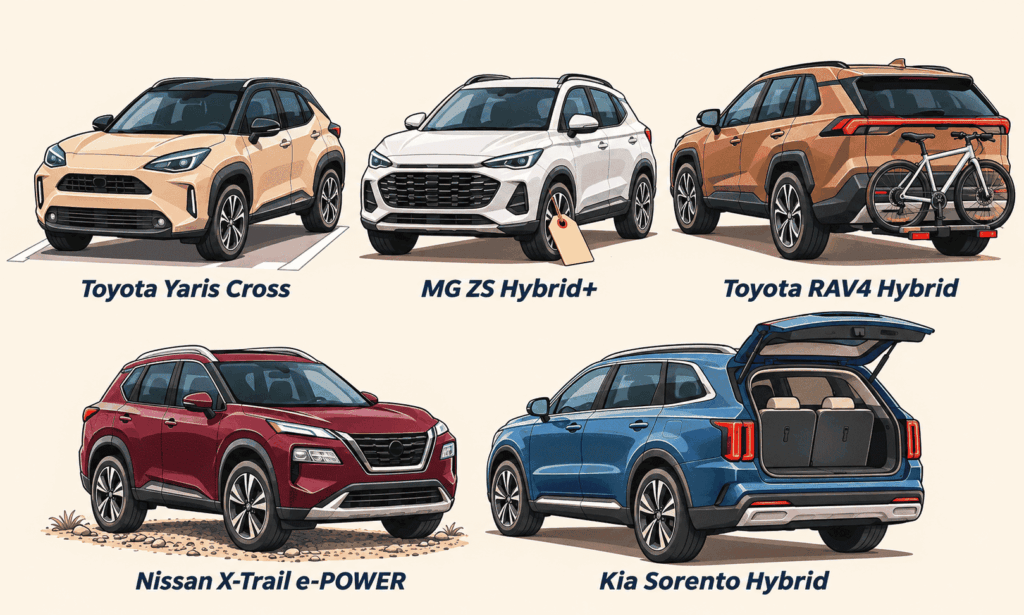
Toyota Yaris Cross GX Hybrid for city driving
The Yaris Cross GX is 4.18 metres long. If your parking spot has a concrete pillar on one side and someone else’s SUV on the other, that measurement could matter more than anything on the equipment list. The front-drive GX also has the lowest claimed fuel use of the full hybrids here, at 3.8 L/100km on regular 91-octane unleaded.
There’s a good reason to stick with two-wheel drive for suburban use. Toyota quotes up to 390 litres of luggage space in the 2WD Yaris Cross and 314 litres in the AWD. If a folded pram is coming along most days, take it to the viewing. Five seats and a boot capacity in litres can’t tell you whether the pram will fit with the parcel shelf in place.
MG ZS Excite Hybrid+ for a smaller budget
The important word on the listing is Hybrid+. MG also sells a petrol ZS Excite. The Hybrid+ gets a 1.5-litre petrol-electric system, front-wheel drive and a 360-degree camera. That camera is a welcome inclusion in the less expensive hybrid grade, especially if you regularly reverse out between two larger cars.
The November drive-away offer includes $2,000 in savings and puts the Excite Hybrid+ within a $30,000 budget for eligible buyers. It uses more petrol on paper than the Yaris Cross, so get both purchase prices in writing before deciding how much the Toyota’s lower fuel use is worth to you.
There’s an extra detail if you’re buying a demonstrator or used ZS. ANCAP gave the earlier hybrid four stars in 2024. After a safety upgrade, cars built from 4 December 2025, starting at VIN LSJWS4395TZ074065, qualify for the updated five-star rating. Two cars first registered in the same year can fall on different sides of that change. Check the ANCAP build-date and VIN details.
Toyota RAV4 GX Hybrid for a family of four or five
If you need one SUV for the school run, a supermarket shop and the occasional week away, the sixth-generation RAV4 GX is our starting point. The $45,990 front-drive model gives you five seats, a 2.5-litre full hybrid and a claimed 4.5 L/100km. Dual-zone climate control and five USB-C ports come with the GX, so you can keep everyone’s devices charged without moving up a grade.
Where the decision gets interesting is towing. The GX 2WD is rated for 800 kg braked. The GX AWD lifts that to 1,500 kg and lists at $49,340 before on-roads. If you have a camper trailer, check what it weighs loaded and the vehicle’s other load limits before paying the extra $3,350. If your weekends usually involve bikes on a rack and bags in the boot, the front-drive version deserves the first look. Compare the Australian RAV4 grades.
Nissan X-Trail ST-L e-POWER AWD for electric drive without a plug
In the X-Trail e-POWER, electric motors turn the wheels. The petrol engine generates electricity, so you still stop at a servo and you never need to find a charger. The engine can run while you’re moving at a steady speed or when the battery needs topping up. Listen for that on a test drive, especially if you’re coming from a conventional automatic.
The ST-L e-4ORCE is the all-wheel-drive version. Nissan also offers a front-drive ST-L e-POWER at $45,990 before on-roads, with claimed consumption of 5.4 L/100km. That gives you a choice. AWD adds $3,090 and takes the claim to 6.1 L/100km. Both hybrids seat five. Some petrol X-Trails have a third row, so check the badge if a seven-seat listing catches your eye.
Kia Sorento Sport Hybrid for seven seats
The most useful Sorento figures are 179 litres and 608 litres. That’s how much boot space Kia quotes with all seven seats up and with the third row folded. For school pickups, the extra seats might be just what you need. For a week away with seven people, 179 litres has to cover everyone’s luggage. Bring the biggest bag you usually take and try it with the tailgate shut.
The Sport FWD pairs a 1.6-litre turbo four-cylinder hybrid with a six-speed automatic and claims 5.4 L/100km. The Sport grade also gives the back row its own fan control and vents. At the viewing, try fitting your usual child seats, then check how someone would get into row three with them in place. You’ll learn more about living with the Sorento in that minute than you will from looking at photos of an empty cabin.
BYD Sealion 5 Essential for an affordable plug-in
The five-seat Sealion 5 makes home charging worth considering at a list price of $33,990 before on-roads. The Essential claims 71 km of electric driving on the NEDC test. It takes AC charging at up to 3.3 kW and has no DC fast-charging port. That setup suits a car which can sit plugged in for hours where you park.
BYD publishes two figures that help explain the trade-off. For the Essential, it claims 1.2 L/100km with 25 to 100 per cent battery charge under test conditions and 4.5 L/100km below 25 per cent. Both are lab figures. If you rarely plug in, the low-charge figure is the more useful starting point for comparison. For the days you do charge, add the electricity you pay for at the wall.
There’s also a safety consideration at this price. The Sealion 5 earned three stars in ANCAP’s 2026 assessment, which applies to both grades. ANCAP identified weaknesses in crash avoidance and safe-driving assistance. If you’re choosing a family car, it’s worth reading the findings alongside the price and range. Read the Sealion 5 safety assessment.
Toyota RAV4 XSE Plug-in Hybrid for a longer electric commute
Say your return trip to work is 80 km and you can charge overnight. That’s beyond the Sealion 5 Essential’s 71 km lab claim, while the RAV4 XSE 2WD gives you more room to spare at a claimed 154 km on the same test. A longer commute is one reason you might actually use Toyota’s bigger electric range. For a 15 km round trip, much of that extra capacity could sit unused.
The XSE also accepts DC charging at up to 50 kW and three-phase AC at up to 11 kW. The catch is the purchase price. With the mandatory paint included, the XSE 2WD starts at $59,515 before on-roads. That’s $13,525 above the GX full hybrid, though the XSE also brings extra equipment. Work out how many of your own kilometres you’d switch from petrol to electricity before assuming that gap will pay for itself.
Two used hybrid SUVs worth a closer look
2025 Toyota RAV4 GX Hybrid 2WD. A late fifth-generation GX claims 4.7 L/100km and takes regular 91-octane unleaded. The sixth-generation 2026 GX 2WD claims 4.5 L/100km and Toyota specifies 95 octane or higher. At 15,000 km a year the difference between the claims is only 30 litres. Put your local price for each fuel into the calculation. The older car’s condition, service record and asking price could matter much more than the small difference on the label. When comparing used Toyota RAV4s, match the generation and drivetrain first.
2024 Lexus NX 350h Luxury 2WD. Look for the little ‘h’. The NX 250 is petrol, the 350h is a full hybrid and the 450h+ is a plug-in. The front-drive 350h Luxury gives you heated front seats, a 520-litre boot and a 5.0 L/100km combined claim on premium unleaded. It’s the used pick if you want those cabin comforts without arranging home charging. Before agreeing on a price, get an insurance quote and check what servicing and tyres are due. A used luxury SUV can fit your purchase budget well before it fits your annual budget.
How to choose between a full hybrid and a plug-in
A full hybrid (HEV) blends petrol and electric power and can drive on electricity alone for short periods when conditions allow. It recovers some energy as you slow down through regenerative braking. That’s useful on a stop-start commute. On a long, steady motorway run there are fewer chances to recover energy that way.
A plug-in hybrid (PHEV) has a battery you can charge externally. Add up the distance from home to work, on to the shops and back home again. If you want to do the whole loop on electricity, that’s the distance to compare with the car’s electric range. The petrol engine can take over on longer days. If you park on the street, check whether charging at work is dependable, how much it costs and whether the space is free when you arrive.
A mild hybrid (MHEV) uses electrical assistance to help the engine. Its badge alone gives you little reason to expect an electric commute. That’s why the shortlist concentrates on full hybrids and plug-ins. The Australian Government’s hybrid guide explains how the different systems are tested.
What to check before buying a used hybrid SUV
- Start with the paperwork and make sure it belongs to the car in front of you. Check the VIN, build date, trim and drivetrain, then go through the service book and invoices for dates and kilometres. A logged service may only cover the petrol engine and say nothing about the traction battery.
- Ask to see what the battery records show. If the manufacturer or a specialist has produced a diagnostic report for that model, request it and look at the date and what was actually measured. A full-charge reading on the dashboard only tells you how full the battery is right now. It says nothing about how much capacity it has held onto over the years.
- Take it on the sort of drive you’d do every week. Fit in a few stops, a hill and some time at your normal cruising speed, and watch for any warning light that stays on. If it’s a plug-in, ask to see charging start, check the cable that comes with the car and agree on the starting charge before you try electric mode.
- Confirm what cover and history sit against that VIN. Ask the manufacturer how much vehicle and battery cover is left and whether any recall work is still outstanding. A PPSR vehicle search can show a registered security interest and usually includes any recorded stolen or written-off status. It won’t tell you anything about the mechanical condition, so it works best alongside an inspection.
Once you’ve settled on a size and a charging routine, browse used hybrids on Cars24 and compare cars of the same grade. Bring the pram, the passenger who usually gets the back seat or the measurements of your garage. Any one of those can settle a close call faster than another decimal place on the fuel label.
Frequently asked questions
Which hybrid SUV uses the least petrol?
The Toyota Yaris Cross GX 2WD. Of the full hybrids compared here, it has the lowest official combined figure at 3.8 L/100km. A plug-in can look even thriftier on a short run with a charged battery, but that’s electricity you’ve paid for too. Price both before you pick a side.
Can I buy a new hybrid SUV for under $30,000 drive-away?
Yes, if the MG ZS Excite Hybrid+ suits you. The MY26 car is advertised from $28,990 drive-away at participating dealers, for eligible cars sold and delivered between 1 November and 31 December 2026, while stocks last. Ring the dealer about stock and paint, then get the final written price for your postcode. Check the quote says Hybrid+, because a turbo petrol Excite sits in the same range.
Is a hybrid SUV worth it if I mostly drive on the highway?
The answer sits in two numbers: how far you drive each year and what the car you’d otherwise buy uses. Say there’s a 1 L/100km gap over 20,000 km. That’s 200 litres, which comes to $400 a year at an assumed $2 a litre. Hold that figure against the difference in purchase price, and cost each car’s fuel at the grade it takes.
Can I use a plug-in hybrid if I can’t charge at home?
You can, and a dependable charger at work makes it much easier. Find out what it costs, which hours you can use it and how much AC the car will accept. The BYD Sealion 5 is a case in point. It has no DC fast charging and AC tops out at 3.3 kW, so a quicker public charger changes nothing. No regular charging at all? A full hybrid is the simpler shortlist.
Which seven-seat hybrid SUV works for a family with a pram?
The Kia Sorento Sport Hybrid has the seven seats. The boot is the catch, since Kia quotes just 179 litres behind the third row. Bring the folded pram along and test it with every seat you need filled. If it’s usually five of you, folding the third row gives you 608 litres.
Is an AWD hybrid SUV worth paying extra for?
Check what AWD changes on the exact car in front of you. On the 2026 RAV4 GX Hybrid, braked towing climbs from 800 kg to 1,500 kg. On the Yaris Cross you lose boot space instead, from 390 litres to 314. Towing a particular trailer, or packing tight? Look at those figures first.
How much battery warranty is left on a used hybrid?
Ask the manufacturer, and give them the VIN, first delivery date and service record. An eligible Toyota hybrid gets five years of traction-battery cover. Annual battery health checks, done as part of routine servicing, then add a year at a time up to ten years from first delivery. Eligible faults are covered. Normal capacity loss isn’t. Looking at a car around five years old? See whether the checks are on record and when the next one is due. See Toyota’s Australian warranty terms.
Should I buy the newer RAV4 Hybrid for better fuel economy?
If fuel economy is the whole reason, run the dollars first. On combined claims the 2025 and 2026 GX 2WD hybrids are only 0.2 L/100km apart (4.7 against 4.5), and they take different grades of petrol. The 2026 car needs 95 RON premium unleaded. Once that’s sorted, put the newer car’s equipment and warranty next to the older car’s price, kilometres and service history.
Comments
New Comment